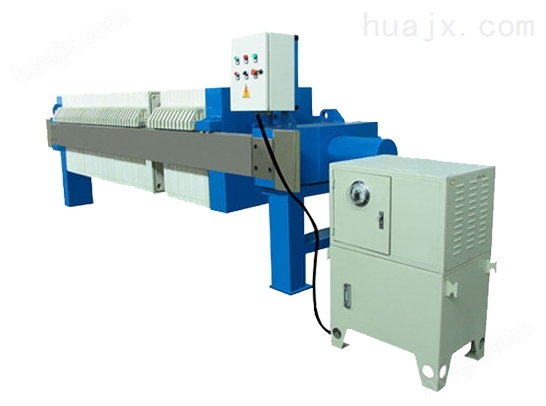
Product Overview
Plate and frame filter press is an intermittent solid-liquid separation equipment, which is composed of filter plates and filter frames arranged to form filter chambers. Under the pressure of the feeding pump, the feed liquid is sent into each filter chamber, and the solid and liquid are separated through the filtering medium. Widely used in chemical, dye, petroleum, ceramic, pharmaceutical, sugar, food, starch, maltose, paint, metallurgy, and sewage treatment in various industries. It has the advantages of good separation effect, wide applicability, simple operation, and low investment, especially for the separation of viscous fine materials, which has incomparable *.
Application scope of plate and frame sludge filter press:
Widely used in chemical, dye, petroleum, ceramic, pharmaceutical, sugar, food, starch, maltose, paint, metallurgy, and sewage treatment in various industries.
Characteristics of Plate and Frame Sludge Filter Press:
It has the advantages of good separation effect, wide applicability, simple operation, and low investment, especially for the separation of viscous fine materials, which has incomparable *.
Structural characteristics and working principle of plate and frame filter press
The X (B) MA/630 manual filter press consists of a frame, filtration, and transmission system.
1. Rack
It is connected by a tail plate wire mother bracket and a crossbeam, used to support the filter plate and transmission mechanism.
2. Filtering system
Composed of filter plates and filter cloth. Use a pump to transport the suspension to be filtered into each compacted filter chamber. The liquid in the suspension passes through the filter cloth and is discharged outside the machine through the filtrate holes on each filter plate. The solid particles in the suspension accumulate in the filter chamber and gradually form a filter cake. The filter cake fills the filter chamber and completes a filtration cycle.
3. Transmission system
Composed of a lead screw, a lead screw, and a manual hydraulic station. When tightening the filter plate, first use your hand to turn the screw handwheel to advance the head plate. After the filter plate is initially tightened, use hydraulic pressure to tighten it. When the pressure reaches 20MPa, stop applying pressure and tighten the locking nut (but be sure to note that the hydraulic tightening stroke should not exceed 50mm. If the stroke has reached 50mm but the pressure has not yet reached 20MPa, the hydraulic system can be loosened and the screw can be tightened again before applying pressure). Otherwise, the filter plate can be loosened.