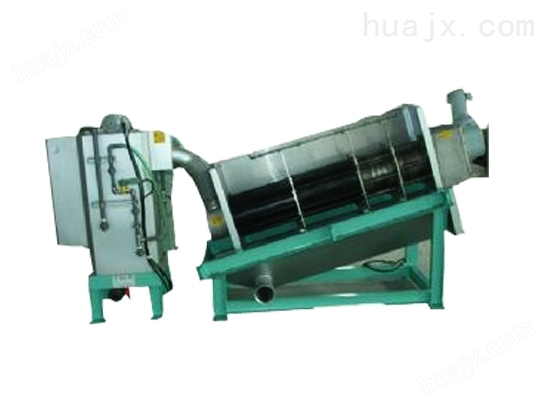
Product Overview
The stacked screw sludge dewatering machine integrates concentration and dewatering without the need for a sludge thickening tank; No filter cloth, no blockage, self-cleaning, suitable for oily sludge; Low speed operation, no noise, ultra-low energy consumption, only 1/20 of that of a centrifuge; Fully automatic control and simple operation management.
1. The equipment design is compact and the workshop has a small usable area. Approximately 50% of the usage area of plate frame and belt filter presses, reducing infrastructure investment.
2. Advanced design, no blockage during operation, reduces flushing water consumption, saves water costs, and reduces the internal circulation burden caused by backflow of cleaning water.
3. The electrical control cabinet, coagulation mixing tank, and dewatering main body are integrated, reducing the footprint and making installation simple and convenient.
4. The dehydrator is basically in closed operation, and the treatment is stable and timely, reducing the odor on site and improving the working environment for workers.
5. Realize fully automatic 24-hour continuous operation, reduce the labor intensity of operators, shorten daily maintenance time, and simplify maintenance operations.
6. The power consumption is very low, which can save a lot of production and processing costs during use, in line with the principle of energy conservation and efficiency. The spiral shaft has a low operating speed, 2-3 revolutions per minute, and there is basically no vibration or noise on site.
7. Widely used and technologically mature in China. The stacked screw sludge dewatering machine is suitable for sludge in industries such as municipal sewage, food, beverage, chemical, leather, welding materials, papermaking, printing and dyeing, and pharmaceuticals. Suitable for dewatering high and low concentration sludge. When dewatering low concentration (2000mg/L~) sludge, there is no need to build concentration tanks or storage tanks, which reduces construction costs, decreases phosphorus release, and reduces anaerobic odor generation.