Product Overview
Product Overview:
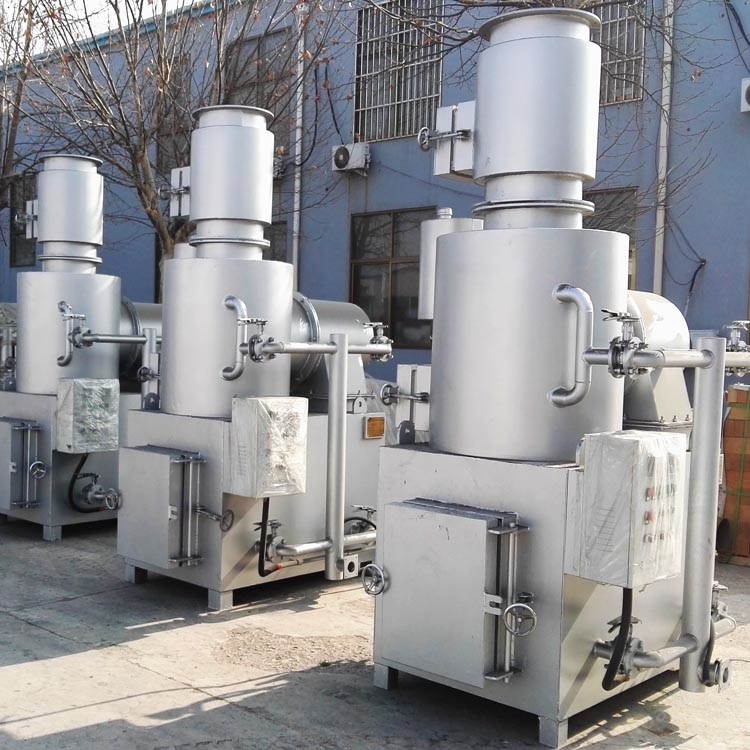
A small-scale household waste incinerator uses mature incineration technology and equipment to process various animal carcasses, feces, medical solid waste, and laboratory solid waste. This equipment has the following characteristics:
Well designed and occupying a small area; Easy to operate and maintain; Energy conservation, safety and reliability; Low price and long operating life. The equipment has excellent craftsmanship and consistent quality, fully realizing the "harmless, non quantitative, and stable" treatment of solid waste. It is an ideal equipment for safe disposal of solid waste in various types of farms, livestock farms, veterinary hospitals, zoos, and laboratories.
Execution standards:
National HT/T18-1996 "Standard for Pollution Control of Small Incineration".
1. Using diesel combustion.
2. Ignition method: automatic ignition
4. Operation mode: Continuous operation
5. Waste gas treatment method: high temperature+high temperature jet vortex combustion+secondary combustion+cyclone dust collector+chimney.
6. Incineration temperature: 600-900 ℃ (adjustable temperature control)
7. Furnace pressure: adopting negative pressure design, no backfire
8. Design average calorific value: 2500Kcal/Kg.
9. Total land area: 3 meters x 3 meters, equipment land area is 2.6m long x 1.4m wide x 2.8m high (floor standing chimney)
Adopt a simple rain shelter.
Safety indicators:
1. Before stopping operation, the device detects the cooling program of the combustion chamber, so that when the combustion chamber temperature drops to the set temperature, the incinerator stops all operations.
2. There are connection protection devices between the control cabinet and each control equipment to prevent leakage. At a relative humidity of 85%, the insulation resistance of the electrical circuit is not less than 24M Ω, and there is a grounding wire to transmit the leakage power. There is a metal hose for protection outside the connection.
3. This equipment has been verified by the technical department before leaving the factory. It is securely installed in oil and gas circuits and has undergone pressure testing to ensure no leakage.
The composition of the incineration device includes:
The furnace body includes a primary combustion chamber, a secondary combustion chamber, a cyclone dust collector, a chimney, a flue, a piping system, a high-pressure blower, a secondary pressure induced draft fan, a primary combustion machine, a secondary combustion machine, an electrical control cabinet, a temperature display device, a detection device, etc.
Combustion process flow and brief description:
The waste is manually input into the primary combustion chamber of the furnace body, and automatically temperature controlled to start primary combustion. According to the principle of combustion three T (temperature, time, vortex), it is fully oxidized, pyrolyzed, and burned in the combustion chamber of the furnace body. The smoke generated by incineration enters the secondary combustion chamber, and harmful substances that have not been completely burned in the smoke are further destroyed in the secondary combustion chamber. In order to decompose unburned substances and meet emission requirements, the secondary combustion chamber is equipped with a burner for combustion assistance and a secondary air supply device to ensure that the flue gas fully contacts with oxygen at high temperatures. At the same time, the residence time of the flue gas in the secondary combustion chamber is ensured, and the air supply volume is adjusted according to the oxygen content of the flue gas at the outlet of the secondary combustion chamber. The temperature inside the secondary combustion chamber is controlled and the larger particles of dust are removed through a dust collector, achieving an incineration efficiency and destruction removal rate of over 99%, making it odorless, odorless, and smoke-free, meeting national emission standards. Then it enters the chimney and is discharged into the atmosphere. The ash produced after combustion is manually removed, screened, transferred, and buried.
Advantages of the furnace:
Design lifespan: The incinerator can meet the needs of all-weather operation, and can operate continuously and intermittently. The annual operating time is not less than 8000 hours, and the design lifespan is greater than 10 years.
The outer shell of the furnace body is made of steel structure, and the inner wall is made of refractory casting materials with different properties. The inner layer is made of high temperature resistant casting material, which can withstand high temperatures up to 1790 ℃. The middle layer is made of lightweight refractory material, which can ensure sufficient combustion temperature inside and maintain low temperature of the outer shell to prevent burns. The refractory material is cast as a whole, which is not easy to fall off and corrode.