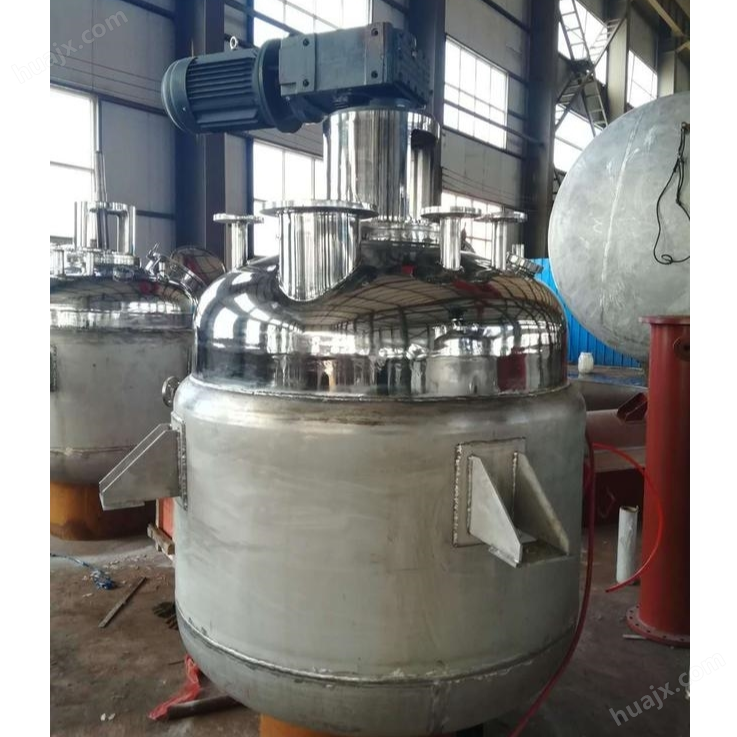
Product Overview
Application of steam reaction kettle: This equipment is suitable for reaction concentration of liquid materials in pharmaceuticals, food, light industry, chemical industry, etc.
Structure and characteristics: Depending on the properties of the material, the inner pot of the reaction vessel can be made of carbon steel or stainless steel. There are four types of material heating available: electric heating rods, thermal oil, steam, and far-infrared heating.
Product Introduction
Steam Heating Reactor Instructions: (Steam Heating Reactor, Thermal Oil Circulating Heating Stainless Steel Reactor, Electric Heating Reactor, etc.). The reaction kettle consists of a kettle cover, a cylinder body, a jacket, a stirrer, a shaft seal transmission device, and a support. The kettle body and components in contact with the materials inside the reaction kettle are made of OCr18Ni9 or 1Cr18Ni9Ti stainless acid resistant steel plate.
Application of reaction kettle: This equipment is suitable for reaction concentration of liquid materials in pharmaceuticals, food, light industry, chemical industry, etc.
Structure and characteristics: Depending on the properties of the material, the inner pot of the reaction vessel can be made of carbon steel or stainless steel. There are four types of material heating available: electric heating rods, thermal oil, steam, and far-infrared heating. The reaction kettle consists of a pot body, pot cover, stirrer, transmission shaft, shaft sealing device, transmission device and other auxiliary components.
Operation requirements: Heating should be done slowly, especially during secondary heating, to prevent the boiling of oil and water vapor. When there is no material in the pot and the pot is empty, do not turn on the heating power supply or heat the oil jacket for testing. Circulating heat transfer oil heating cannot be replaced by steam heating. Thermal oil circulation heating is suitable for reaction vessels and resin complete equipment with a capacity of over 500L. When ordering the above equipment, the working pressure, working temperature, and working medium should be clearly stated. Other special specifications can be designed separately.
Application: The steam reaction kettle is suitable for production environments with industrial steam. It has fast heating temperature, accurate temperature control, can achieve material heating, and quickly switch to cooling, internal constant temperature, cleaning and sterilization functions. It can achieve automatic control of temperature, stirring, and material liquid. Suitable for customization.
In order to correctly use, maintain, and clean the reaction kettle, standardize and normalize various operations, extend the service life of equipment, ensure safe production, and stabilize product quality, several suggestions are proposed on how to correctly use the steam reaction kettle:
1. During operation, try to avoid contact between the outer shell of the kettle and corrosive liquids such as acid and alkali. Once materials come into contact, they should be wiped clean with a cloth in a timely manner;
2. Do not rinse the equipment with water to avoid damage to the insulation layer;
3. When the temperature is ≤ 0 ℃, the water stored in the jacket should be drained after use to avoid damage to the equipment due to freezing;
4. For reaction vessels equipped with mechanical seals, the sealing parts should be kept clean;
5. If there is a blockage at the bottom of the kettle during discharge, metal tools should not be used. Bamboo poles, plastic sticks, or wooden sticks can be used to gently poke open.