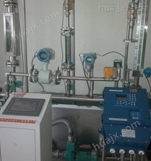
Product Overview
System composition principle: The distributed quantitative loading control system consists of loading control instrument, flow meter, thermometer, liquid level switch, grounding switch, control valve, explosion-proof LED screen, upper computer, etc., forming an automated quantitative oil delivery system. The system can run independently and be operated and monitored locally by operators; It can also be connected to the computer in the control room through communication cables to achieve job control. Summarize the on-site loading situation to the control room for centralized monitoring, management, display, and printing of various loading reports by computers.
Main functions:
1. Automatic oil delivery and centralized management functions: can achieve automation of the oil delivery process, ensure loading accuracy of ± 0.2% or more, and improve production efficiency
2. Safety alarm protection function: It can realize various fault alarms, as well as electrostatic overflow protection and emergency stop protection
3. Loading process monitoring function: online monitoring of the oil delivery status of each crane position
4. Ticket exchange and oil delivery: Customized printing of loading tickets and storage of these tickets, with password recognition function
5. Offline loading function: The upper computer cannot operate the room and can easily switch to on-site loading
6. Management function: Accept production data and production plans from various management networks of superiors to arrange production, and generate various reports
7. Communication networking function: Provides standard DDE and OPC interfaces, which can communicate with control and management systems such as DCS and ERP.
Main features:
1. Adopting domestically produced CFZ quantitative loading control instrument with imported performance
2. * Ethernet and RS485 are two optional networking methods
3. The communication between the upper computer and the loading instrument adopts two standard methods: TCP/IP and MODBUS RTU
4. The upper computer software can use powered configuration software for easy maintenance
5. Flexible configuration method makes the selection of on-site instruments more convenient and flexible
6. Chinese environment with both upper and lower computers using *
7. Easy to expand and integrate with modern network technology
CFZ Quantitative Loading Control Instrument
The CFZ explosion-proof distributed quantitative loading control instrument is a new type of intelligent explosion-proof instrument with an intelligent controller as its core.
Equipment structure:
1. Industrial and core intelligent controllers
2. Industrial and integrated LCD screen operation terminal
3. Other industrial accessories
Application fields:
1. Quantitative loading and barrel loading of liquid materials in industries such as petroleum, chemical, and pharmaceutical
2. Quantitative batching machine in the production process and quantitative control of other processes
Main functions:
1. Data collection and quantitative control functions
2. Parameter setting and sequence control function
3. Oil spill interlock, grounding interlock, emergency stop interlock, power failure protection function
4. Remote/on-site loading conversion function
5. Implement monitoring and alarm functions
6. Communication networking function
7. Equipment self-test and password protection function
Key Features:
1. Simple structure and extremely stable performance
2. Modular design and easy maintenance
3. Provide standard RS485 and J45 communication interfaces
4. Provide standard MODBUSRTU and TCP/IP protocols for easy networking, configuration, and communication with other PLC, DCS, and other systems
5. Provide multiple data acquisition interfaces such as pulse input, AI, AO, DI, DO, etc., with a wide range of applications
Technical Indicators:
Power supply AC 220V, 2A, 50Hz
LCD display module with high brightness STN for LCD display
Keyboard input with 24 keys (optional built-in IC card)
The device self checks and automatically detects the working status, which can be remotely monitored
The flow signal can be connected to four sets of 0-10kHz pulse inputs and two (4-20) mA analog signals
The valve position signal can be connected to up to 13 switch contact valve position signals
Adjust the output to 4-20mA, and use PID circuit to control electric or pneumatic regulating valves to achieve constant current or constant pressure control
Relay output AC220V, 5A, can control 10 valves or pumps
System accuracy, cumulative flow error (0.1% FS)
The operation mode can run continuously for 24 hours without interruption, and can be operated locally or remotely
Working temperature -40 ℃~70 ℃
Storage temperature -50 ℃~80 ℃
Relative temperature 0-100 ℃
Vibration with a displacement of 0.5mm, (10~55)Hz, 2-hour XYZ three-way
Set the quantitative range from 0 to
Communication interface RS485
Communication protocol standard Modbus RTU (serial port), which can directly communicate with third-party DCS hardware
Communication speed 10Mbps (Ethernet), 600-11220bps (serial port)
Mean Time Between Failure (MTBF)>100000h (11 years)
Explosion proof mark ExdIIBT6
Install wall mounted (optional)
Size 400mm × 380mm × 250mm
Electrical interface size G1 "(4 pieces)