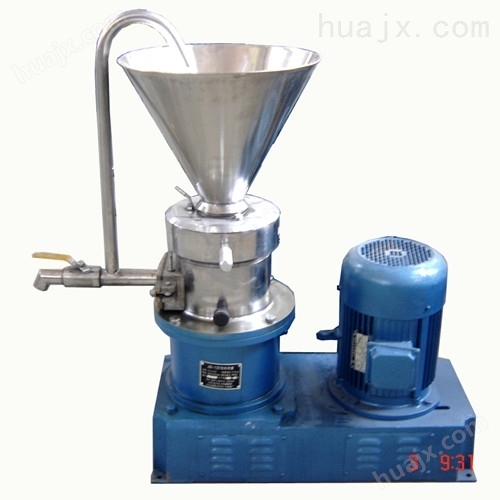
Product Overview
The basic principle of a horizontal colloid mill is to use high-speed relative linkage between fixed teeth and moving teeth. Except for the motor and some components, all parts that come into contact with the material in the colloid mill products are made of high-strength stainless steel. Especially, the key dynamic and static grinding discs are strengthened, so they have good corrosion resistance and wear resistance, making the processed materials pollution-free, hygienic and pure.
The widespread application of colloid mills;
Food industry, chemical industry, pharmaceutical industry, daily chemical industry, construction industry, paper industry, battery industry, etc.
Advantages of colloid mill:
Compared to pressure homogenizers, colloid mills are primarily centrifugal equipment with the advantages of simple structure, easy maintenance, and suitability for materials with higher viscosity and larger particles. Its main drawback is also determined by its structure. Firstly, due to centrifugal motion, the flow rate is not constant and varies greatly for materials of different viscosities. For example, the same equipment can have a flow rate difference of more than 10 times when handling viscous paint materials and thin dairy fluids; Secondly, due to the high-speed friction between the stator and the material, a large amount of heat is easily generated, causing the processed material to denature; Thirdly, the surface is prone to wear, and after wear, the refinement effect will significantly decrease.